

What’s the GOAT song?
GOAT is an acronym that the younger generation uses: It stands for Greatest Of All Time. Now, of course, that’s going to be a pretty subjective judgement in most areas, especially in music. There are a bazillion songs out there, and nobody’s heard them all. At the very least, we’d have to narrow the field down. Do we mean Western songs? Let’s say, yes. Do we mean modern, popular music from about 1960 onward? Again, let’s say, yes. These narrowings would eliminate Schubert Lieder from contention, for example, as well as Billie Holliday’s work.
Clearly, I’m zeroing in on my own time and cultural space, since I was born in 1961 in the United States. For the sake of argument, let’s go along with that. I think my space would be roughly congruent with that of many of my readers.
I think I could get many if not most of my readers to agree that the GOAT band (whether or not it’s the one they most enjoy listening to) is the Beatles. They are the best-selling, the most innovative musically and stylistically, the most influential. Now, the GOAT song doesn’t have to be by the GOAT band, but in my opinion, keeping in mind that I haven’t heard all of the bazillion songs, it is. It is their magnum opus, “A Day in the Life.”
“A Day in the Life” is a difficult song to wrap one’s brain around. Just what is it about? Taken literally, it’s about getting up, catching the bus, reading the newspaper, and going to the movies. Veritably, a day in someone’s life. Not that different from Lou Reed’s “Perfect Day.” It’s basically an experience song.
I’ll embed the most recent re-mix by Giles Martin, son of the original producer George Martin, here. I recommend headphones or good speakers, because it sounds a lot better than old mixes. I’ll link and embed performances by other artists later.
What separates it from other experience songs is the complexity of feelings. The opening acoustic guitar sets a melancholy mood, while the piano introduces a note of majesty. (The piano does this repeatedly, when speculating about the crash victim being from the House of Lords and when mentioning the Albert Hall, but the majesty is often tinted with irony).
The verses about the car crash, the film, and the potholes, are all sardonically delivered by John Lennon, who adds that he’d love to turn us on, presumably with drugs, not with sex. Paul McCartney’s middle eight about the morning routine is more earnest, but it leads to Lennon’s dreamy “ah ah ah ahs” buoyed triumphantly by the orchestra. All the while Ringo Starr’s intricate drum fills comment on the proceedings sustaining the subtle complexity of feeling. (One classical critic calls Starr’s work here “Beethovian.”) George Harrison has almost nothing to do on this song, because it does not feature an electric guitar.
The most striking things about the song are of course the chaotic orchestral glissandos and the final chord. McCartney had been listening to a lot of avant-garde music by composers such as Karlheinz Stockhausen, and he and Lennon wanted to stitch together the verses and the middle eight with something that sounded like—depending on whose account you go by—the end of the world or a sonic orgasm. They worked with George Martin until they arrived at the idea of having the instruments play from the bottom of their compass to the top separately and in a meandering path over 24 bars. Martin wrote out rough wavy notation for the musicians. It was like a giant steam engine warming up twice. After the second time three pianos and a harmonium simultaneously sound a loud E-major chord for 40 seconds, which has become the most famous chord in recorded history.
What is the song “about” at a deeper level? I suggest that it is essentially about an ordinary but absurd day as seen through the eyes of someone who uses drugs. (The Beatles were heavily into drugs at the time they made the song.) As such it is the pinnacle of psychedelic rock.
But it goes beyond psychedelic rock, first of all because it goes beyond rock—it is symphonic pop. Remember, it doesn’t even feature an electric guitar. Secondly, you can appreciate the mixture of sensibilities without needing to be chemically “turned on.” I’ve never done recreational drugs, and the song is quite eye-opening to me. I’ve always believed in finding intensity of experience so that I wouldn’t need to do drugs. Music is among the things that are enough to turn me on, and this song does the job. Lastly, there’s a sharpness of perceptions to the verses that undermines any advocacy of drugs, at least in my eyes. We need to dig deeper.
Lennon seems to have gotten the verses from the newspapers and the movies, but they are not reportage. The verse about the car accident he drew from a story about the death of a friend, Tara Browne, the 21-year-old heir to the Guiness fortune who was killed in a car crash. Browne was not a member of the House of Lords, but Browne’s father was. Browne was the person who had introduced Paul McCartney to LSD. It’s sad that he died, and apparently, he did a noble thing by swerving to save the life of his girlfriend passenger, but he does look a bit goofy in this photograph. Maybe that’s what made Lennon laugh.
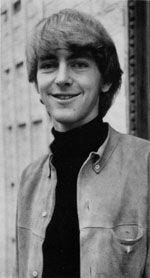
Or maybe it was the image of a crowd of people standing around looking at a car crash speculating as to the identity of the driver. Perhaps Lennon saw them as being like sheep. It’s not definite, but I suspect that the verse is about the absurdity of a random death of “a lucky man who made the grade.”
Ironically, the passenger Browne saved, along with her husband, died in another car crash a year after Lennon’s murder.
The verse about the movie with the English army having won the war possibly came from Lennon’s own experience. He had co-starred in a black comedy directed by Richard Lester made a year before “A Day in the Life” called How I Won the War. It might be characterized as a cross between Catch-22 and Monty Python. It was Lennon’s only non-musical role in a film. He had read the book to prepare for the part. He first wore his trademark granny glasses in the film.
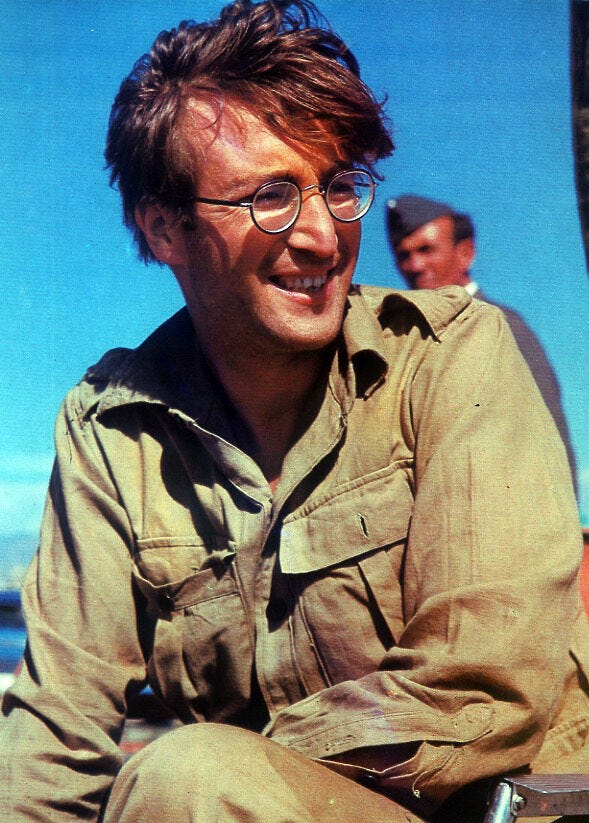
How I Won the War is about WWII, which is a war few people are repulsed by the British victory in. So, perhaps we have to imagine the movie in the song being a movie about a colonial war, in which the English wouldn’t look so good, or maybe something more cynical like Lawrence of Arabia.
Once again people are being sheeplike, reacting as a crowd. Oddly, they stare at a dead body in a street accident, but they cannot watch a movie about their country winning a war. Given Lennon’s anti-war tendencies, perhaps he thought that was commendable, although at the same time it was praiseworthy of him to not turn away. In any case, he wants to console you by offering you drugs.
After the first mighty glissando comes McCartney’s simple ditty about the morning routine. I don’t have much to say about it. It pretty much just anchors Lennon’s verses and leads into the psychedelic “ah ahs,” which I find quite elevated.
The verse about potholes was based on a real newspaper report of how many there were in Blackburn, Lancashire. It didn’t mention the Albert Hall though; it just said that there was one twenty-sixth of a hole per person. At this point we have descended into the absurd, caring in such detail about the condition of the streets. Once again, Lennon offers us the consolation of drugs, and the mighty steam engine revs up, finally conjuring fate with the cosmic chord. The final message that I take away is “Nothing is unimportant, even if it is absurd.”
If I had to distill the sense of life of “A Day in the Life” down to a phrase I would say, “the psychedelic grandeur of absurdism in everyday experience.” That needn’t be a bad thing. Some aspects of life are absurd, and it’s good not to lose one’s sense of the grandeur of life in one’s encounter with them.
There are pieces in classical music that are so difficult to perform that they become a Mount Everestlike challenge for performers: Bach’s Chaconne for violin is one example. I think “A Day in the Life” is an example of such a piece in the popular repertoire—especially in how to play the glissandos. Keep in mind that the Beatles never actually played the song through: it’s a Frankenstein’s monster sewn together of parts in the studio. In this section I would like to discuss other people’s attempts to perform it in one go.
It has been played live virtually exactly as the Beatles composed it by a Dutch Beatles tribute band called the Analogues. They recreate Beatles songs very well, especially the instrumental parts. Here is their version of “A Day in the Life.” They pull it off with a smaller orchestra than the one the Beatles used and only one piano. I’m not sure how. They perform whole later albums by the Beatles, the ones that were created in the studio. This performance is really good if you want to see what a live Beatles song that stays close to the original might have looked like.
If you want something that sounds a bit more different from the original, I recommend another Dutch musician/arranger/conductor, Sam Haug, who created this version of the song for chorus and orchestra. I think it’s being performed by conservatory students, but I can’t get any definite information. It’s not as sardonic as the original, with the chorus performing the glissandos and the orchestra playing the cosmic chord. It’s an all-around happier version than the Beatles’ version, if that’s imaginable. I like it very much.
If you would prefer a sadder rendition, turn to singer/guitarist Chris Cornell. Cornell was famous as the frontman of Soundgarden, who had a big hit with 1994’s “Black Hole Sun.” Unfortunately, Cornell suffered from depression and committed suicide at the age of 52.
He had a gorgeous voice with a big range, and he dared to play the song with just himself on acoustic guitar and Bryan Gibson on cello. His delivery was melancholy. He adds his keening voice to the second glissando, making the song a cry for help. Ironically, this exquisite performance took place in the Albert Hall.
One live performance of “A Day in the Life” won a Grammy, and that’s Jeff Beck’s at Ronnie Scott’s Jazz Club in 2007. Beck is accompanied by electric bass, keys, and drums. There’s no vocalist; Beck did a lot of his work without a singer, putting his stunning guitarwork on display. The song is not even close to a literal recreation of the Beatles’ performance. The keys don’t seem to follow McCartney’s piano. The drums don’t follow Starr’s. Beck makes his guitar wail with liberal use of the whammy bar and distorts his way down the neck to create the glissandos.
It’s very powerful. Definitely super guitarwork. Technically impressive and sort of jazzy. It doesn’t have the same emotional message as the original or Cornell’s message of despair, but it’s definitely worth a listen, especially if you respect Beck.
I could go on and on, but I won’t. You might have fun searching YouTube for “A Day in the Life covers.” Some are quite nice, and I won’t spoil the fun of looking.
But I will link one more. I won’t embed it, because while I think it’s clever, I also think it’s in rather poor taste. It’s by a group called Big Daddy (not the rap group of the same name). In 1992 they covered the entirety of Sgt. Pepper’s in 1950s styles: doo-wop, jazzy, etc. For the concluding track of the album, which is “A Day in the Life,” they opt for the style of Buddy Holly.
This is actually quite apt. The Beatles modelled themselves on Buddy Holly and the Crickets, right down to the insect name. In “A Day in the Life” Lennon sings “oh boy,” three times, and Holly did a song called “Oh Boy.” That last bit might be coincidental, but Big Daddy exploits it, incorporating the Holly Hiccup and the celesta (the glockenspiel-sounding instrument) from “Everyday” into their cover.
But where it crosses the line is that it uses airplane sounds during the glissandos and the final crashing chord is the sound of an airplane crashing—just as Buddy Holly died in a plane crash. I wouldn’t even link something that uses Buddy Holly’s death as fodder for a joke, except that Big Daddy did find the subterranean connection between Holly and the Beatles. You can check it out here.
So, here is a multifaceted look at the song I would nominate for GOAT within certain parameters. We have the complex original, the Analogues’ facsimile, Sam Haug’s sunnier version, Chris Cornell’s heart-full-of-despair rendition, Jeff Beck’s technical wonder, and Big Daddy’s clever parody. There’s so much to what Lennon, McCartney, Martin, and Starr created that it lends itself to many different interpretations. I think it goes beyond its creators’ intentions of it as an absurdist drug song to a thing of wonder, overcoming despair and incorporating a cosmic epiphany into the mix. Not bad for four lads who just a few years earlier had started out as a boy band.
Jeff Beck's interpretation of the piece is particularly stunning. Nice writing!