
Hamnet
The Genius of Agnes and Will

We wanted to see this movie directed by Chloé Zhao for the longest time, but it did not play at a convenient theater at a convenient time. Finally, when it was nominated for a best picture Oscar, it came to a local cinema and we had our chance. It was very much worth the wait.
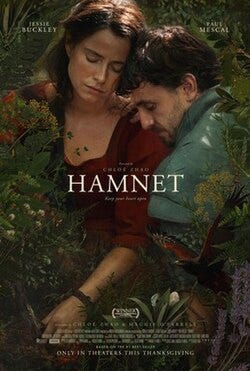
Hamnet is the story of William Shakespeare’s family, although he is not named until the final fifth of the movie. (He is not named at all in the source novel by Maggie O’Farrell.) But the Bard is not the center of the story; his wife, here styled as Agnes (pronounced an-yes), is. She is miraculously portrayed by Irish actress Jessie Buckley, doing an impeccable English accent. The actor who plays Will, Paul Mescal, is also Irish and also does a great English accent. The dialogue is not in Elizabethan English, so it is not hard to understand. I did catch one anachronism, when Will says “OK.”
The tale takes us through Agnes’ and Will’s courtship and marriage, to the birth of their children to the first performance of Hamlet. Agnes is an herbalist and a bit of a reader of souls. Some might have suspected her of witchcraft, although that is not said in the film. She bears her first child alone in the woods, but the twins she has in the house with her mother-in-law, played in a star turn by Emily Watson helping. Hamnet, the only boy, is one of the twins.
Now I am going to get to spoilers, although I think a lot of people already know the outline of the movie. If you want to be surprised, just take my word that it’s beautiful with beautiful music, acting, and set design and stop reading here. If you want my analysis, please continue.
Hamnet is a special child. He wants to be an actor in his father’s plays. His father teaches him how to mock sword fight with sticks. Will enjoins him to be brave and look after his mother and sisters when he is gone to London.
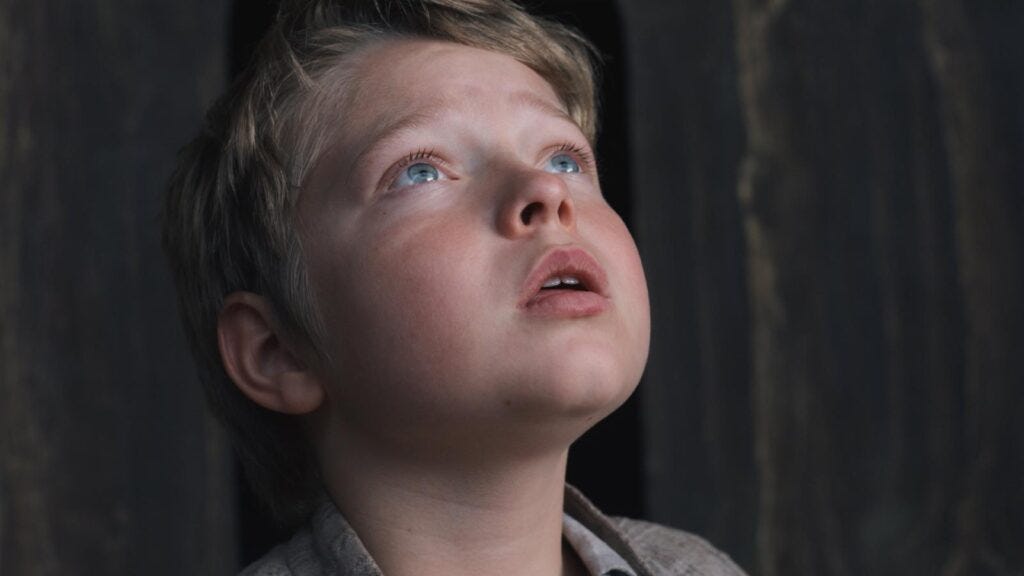
This he does. When the plague strikes and his twin sister lies dying, he crawls in bed with her and somehow gives her his life force and dies in her place. Will hurried back from London to see his daughter, only to find her recovered and his boy dead.
The parents are grief-stricken. That’s what the film is really about: grief. Agnes is in agony and she is angry at Will for not being at home when Hamnet died. Does he even feel grief, or does he just live in his head?
Time passes. Will has become very successful. He has bought the family a big house in Stratford. He gives Agnes jewelry she is not interested in.
Provoked by her stepmother, whom she does not love, Agnes decides to go to London with her brother and see Will’s latest play. She doesn’t realize that it’s Hamlet. As a caption at the beginning of the film explains the names Hamnet and Hamlet were interchangeable in the sixteenth century.
We have been watching Will working on Hamlet. As he composes the “To be or not to be” soliloquy, he stands on the edge of dock, obviously contemplating the Question. We see him directing the actor playing Hamlet in the “get thee to a nunnery” speech, berating him to get the lines just right, obviously very angry.
Agnes and her brother seek out Will’s apartment. They are surprised to find that the man who has bought the big house in Stratford only has a little room with a bed and a desk in London.
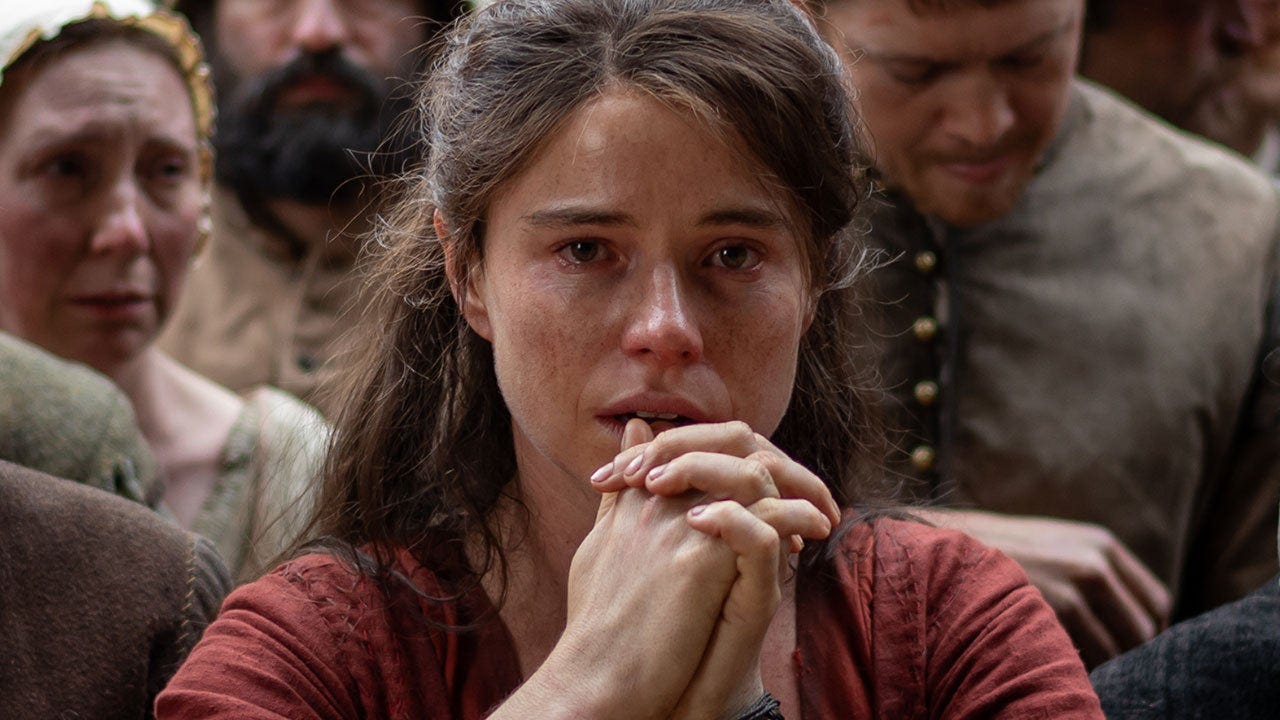
Finally, the siblings enter the Globe and take places near the stage. When the play begins, Agnes is indignant when she learns that Will has taken the name of their dead son. But then something strange happens, and I am not going to spoil it by describing it in detail: the play resonates with Hamnet’s life and Will’s grief, and it melts Agnes’ heart and lets her move on and reconnect with Will. It is an awe-inspiring scene. Paul Mescal is outstanding in it (he plays the ghost of Hamlet’s father) and Jessie Buckley is simply amazing as we watch her reactions to the play. I cried.
Max Richter’s “On the Nature of Daylight” plays in the background. It is gorgeous and moving, although some viewers have complained that it has been used in too many movies before Hamnet. I never saw any of those movies, so I don’t care!
The sets and costumes were completely convincing for the 1500s. My one complaint was that I wished they had given Paul Mescal a receding hairline like the real Shakespeare, but that’s not important. Although the story did not center on Will, it was a convincing portrayal of his rise from being a smalltown Latin teacher to being a preeminent playwright, although that was only in the background of the story.
I wish this film got wider distribution. It’s not really arthouse fare, even though it is “about Shakespeare.” It’s the story of love, family, loss, and processing grief. I think anybody with a modicum of patience would be moved by it.
You might wonder whether how much of the story is true. I’m not sure it matters. Shakespeare made Richard III into a worse villain than he was for political purposes. Artists are not historians. Hamnet might make you think that Will wrote Hamlet soon after his son’s death. Actually, several years had passed, and he had written a couple of comedies in the meantime. But who’s to say on what schedule a man processes grief?
I enjoyed your review, Kurt.