
John Galt, Alternative Christ
Ayn Rand creates her version of the greatest man

My thesis is that John Galt, hero of Ayn Rand’s magnum opus Atlas Shrugged, can be regarded as an “alternative Christ.”
An alternative Christ is an artistic Christ figure intended to displace the “real” Christ by alluding to some of his significant features while negating other features at some profound level. In Galt’s case the negation is at the level of philosophical fundamentals. (I believe that in literary criticism this would be labelled a corrective allusion.) Some readers might say that the philosophical level is the only level that matters and that no other features are significant. That is not the case. Literature works its power by providing concrete representations of abstract feelings and ideas at many different levels. It necessarily deals in allusion, symbolism, texture, and resonance. Literature without these things would be thin gruel indeed.
As Ayn Rand said in the 25th Anniversary Introduction to The Fountainhead, religion has usurped feelings like worship that are legitimate but which ought to have different objects. The proper kind of worship is that embodied in The Fountainhead itself is what Rand termed “man-worship.” Perhaps a Christlike being with the correct philosophy would be the one most worthy of worship, or at least the one best able to steal worship away from what Rand would regard as a false idol like Jesus. In any case, portraying a Christlike figure with the correct philosophy would be the ultimate realization of the goal of Rand’s writing: to depict the ideal man.
Let me be clear, I believe that Rand’s ideas and Jesus’ are opposites at almost every point, and because of this, Galt and Jesus have vastly different personalities. I am not trying to reconcile opposites; I am claiming that Rand systematically likened Galt to Jesus in order to create her own vision of the greatest man ever to live, a vision that corrects the errors of the traditional vision that is Christ. It is clear that Rand liked rewriting traditional myths, as she does when she suggests that Atlas should shrug.
I will develop my thesis in stages. Let’s begin by looking at the idea of the Christ figure and eliminate some objections to referring to Galt as one. Then let’s look at evidence that Galt is an alternative Christ. After I have made my textual case, let us look at some support from Rand’s personal tastes. Lastly, let’s see what we can conclude from all this.
I am not the first person to trace parallels between Galt and Christ, although I think I may be the first to examine the similarities as a pervasive and meaningful likening, based on a close reading of the novel. Susan McCloskey offers some analysis of the Galt/Jesus similarity, but I don’t know how deep she goes since I have not been able to obtain a copy of her lecture on the subject.
1. The Christ Figure.
Here are the first three paragraphs of the Wikipedia entry for Christ figure:
A Christ figure, also known as a Christ-Image is a literary technique that the author uses to draw allusions between their characters and the biblical Jesus. More loosely, the Christ figure is a spiritual or prophetic character who parallels Jesus, or other spiritual or prophetic figures.
In general, a character should display more than one correspondence with the story of Jesus Christ as depicted in the Bible. For instance, the character might display one or more of the following traits: performance of miracles, manifestation of divine qualities, healing others, displaying kindness and forgiveness, fighting for justice, being guided by the spirit of the father character, and the character’s own death and resurrection. Christ figures are often martyrs, sacrificing themselves for larger causes.
In postmodern literature, the resurrection theme is often abandoned, leaving us with the image of a martyr sacrificing himself for a greater good. It is common to see Christ figures displayed in a manner suggestive of crucifixion as well.
I do not take the qualities mentioned to be an exhaustive list of the characteristics a Christ figure would have to share with Christ. And it is clear that a Christ figure need not share all of Christ’s qualities. Many salient features of the Biblical Jesus’ story, such as his descent from a king or his betrayal, do not play a role in most literary Christ figures.
Things are somewhat more complicated in the case of John Galt. Insofar as he is a Christ figure, he calls on the feelings we would have for the greatest man who ever lived, but since Rand uses him as a corrective allusion, we also see traits that are the opposite of Christ’s. That doesn’t create a grab-bag of similarities and dissimilarities that prove nothing, because the similarities are too significant and too numerous, while the dissimilarities are too perfectly antipodal. We’re looking at a clear collection of yeses and noes, and not just a heterogeneous bunch of thises and thats.

The Wikipedia entry gives multiple examples of Christ figures. For instance, Uncle Tom is not at all supernatural and does not work miracles, but does forgive his tormenters and inspires them to reform. Others, such as Harry Potter, die and are resurrected as part of the story, and can do something like miracles but are not ultimately martyred. E.T. (the Extra-Terrestrial) has been viewed as a Christ figure by some movie critics, although not by his Jewish director Stephen Spielberg. Santiago in The Old Man and the Sea suffers and struggles, but neither dies nor redeems anyone.
The literary point of a Christ figure (or any allusion, even an implicit one) is to resonate with the feelings or ideas of the thing being alluded to. For example, Uncle Tom is Christlike because he has a humble origin and forgives his tormentors. Calling on our feelings for Jesus, we are supposed to feel pity mixed with awed respect for Tom. That’s the cash value of the allusion.
The comic book hero Superman is a good example of a Christ figure because he was sent to earth from the heavens (outer space) by his father and saves human beings by using his super-powers, demonstrating repeated willingness to suffer as a rescuer. Note that Superman is not saving us from our sins, but from mad scientists, other aliens and the like. He does undergo death and resurrection occasionally, as in the film Justice League, but those events do not constitute the central episode in his narrative and can easily be omitted from it without significantly changing its message.
Superman doesn’t share all of Christ’s characteristics because we can look up to him without feeling bad about ourselves and because he doesn’t demand anything from us. He does not preach the morality of altruism or ask that we have faith in him. He is a “feel-good” Jesus. Superman makes the reader/viewer feel there’s a strong, pure, benevolent hero looking out for us. Here is an example of how Superman is explicitly treated as a Christ figure:

After reviewing various examples we can see that it does not matter that John Galt is mortal, has no magical powers, and is not killed. Of course eliminating a few superficial objections does not establish that Galt is a Christ figure. It very much leaves two possible fundamental objections: Galt does not preach a message of forgiveness and sacrifice and Galt himself is not a lamb offered up to redeem us from our sins. Galt is the very opposite of Christ in these ways, while other Christ figures usually share at least some of these ethical qualities to some degree.
But that is my point: Galt is clearly not a Christ figure when it comes to morality. As an alternative Christ Galt is intended by Rand precisely to displace Christ’s ethical qualities, just as alternative rock music keeps some the of forms of traditional rock but replaces the mindless kitsch with something more sophisticated. I would claim that Galt parallels Jesus in many aspects but that by deliberately shifting the moral ground from under him, Rand stands Jesus on his head. Rand’s perfect man is similar to Christianity’s, only better. Just as Superman is supposed to make you feel (like Christ does) safe, Galt is supposed to make you feel (like Christ does) awe and worshipfulness at his moral and intellectual perfection. In respect of these feelings Galt is a more perfect Christ figure than Superman. To make my case I have to show that Galt occupies a similar imaginative space as the mythological Jesus. That is the burden that is upon me.
2. Galt as Christ Figure, Some General Considerations.
We can start with an easier and more general claim, namely that Rand intended Galt to be a god figure without necessarily being specifically a Christ figure. We know from a letter to a fan that Rand considered Howard Roark “man as god.” (Letters of Ayn Rand, p. 225) We also know from her essay “The Goal of My Writing” (The Romantic Manifesto, p. 162) that she put Galt in the class of “ideal man” with Roark, Rearden and Francisco, so it follows that she would consider Galt to be man as god too. (Note that Dagny gets left out in the cold, even though she is clearly an ideal woman.)
But consider Galt’s place in Rand’s pantheon. He towers over the other gods. Roark, Rearden, and Francisco are ideal men, but only Galt preaches the good news to the whole world and is the savior of Man (in this case the savior of Man the ideal type from Mankind the unworthy masses). Roark makes a meaningful courtroom speech, but it’s to a limited audience and there’s no suggestion that it’s going to change the world. Francisco makes a couple of speeches, but they are really directed just at Rearden. Rearden himself makes one courtroom speech, and it wins him his case, but Francisco tells him sadly that words of that kind are a century too late to change the world. Of Ayn Rand’s heroes, only Galt speaks to the whole world and changes the whole world by his words and deeds. Galt is the only one of Rand’s men as gods to have done such Christlike things on such a Christlike scale.
Galt as Rand describes him would be the greatest human being who ever lived, a combination of Aristotle (as great philosopher and scientist), Lincoln (as great liberator and orator), and Tesla (as great inventor of marvelous electric technology.) Again, in the context of a Christian culture—and literature must be read in the context of the well-known features of its time and place—any version of the greatest man who ever lived would likely be seen as a substitute for Jesus and would invite a compare and contrast, which in this case would yield an alternative Christ.
3. Parallel Details
Galt is similar to Jesus in some medium-sized details. Like Christ, Galt has a miraculous birth. Dr. Akston says about him “I’ve always thought of him as if he had come into the world like Minerva, the goddess of wisdom, who sprang forth from Jupiter’s head, fully grown and fully armed....” (p. 786) It’s true that here Galt is being compared to a Roman deity not a Christian one, but Minerva is a close parallel to Jesus in that she is a god without normal parents (Dr. Akston uses the word “parentless” to describe him, which rather takes due credit away from Galt’s actual parents.)
Galt is thus symbolically the son of a god from the heavens (Jupiter instead of Jehovah), conceived without sex. Thus we get a divine origin story for Galt like that of Jesus. Of course, the point is that Galt is the wholly self-made man and not the product of a family environment, but Rand did not have to use a mythological allusion to make that point. (She doesn’t about Roark). Her purpose is to separate Galt from normal developmental processes so that he owes nothing to anybody.
In addition, both Galt and Jesus work miracles. Of course Galt’s technological breakthroughs are the product of science, not divine power, but in both cases we see things of wonder that require a special kind of mind to produce. Here we see the alternative Christ pattern of similarity and opposition. Galt is a worker of “miracles,” but his are secular/scientific in origin, not mystical. Mystical powers are not real, and mystical thinking is to be condemned. Galt’s miracle-working displaces Jesus’. But for Rand the greatest man who ever lived ideally should still be a miracle worker in some sense so that we can feel awe toward him.
Finally, Galt and Jesus both have ministries and spend years seeking converts. Unlike Roark, Rearden, and Dagny, Galt and Francisco do not lead the overfull, creative lives of a Rand hero, but instead are on a mission to change the world. Galt has his secret New York laboratory to be sure, but he also has a full-time job in the tunnels of Taggart Transcontinental and presumably a part-time or full-time job recruiting strikers, so it would appear that he doesn’t have as much time to work in the lab as he would have if he weren’t leading the strike. He is sacrificing most of his productive energy and time as an inventor for a crusade. He and Francisco, his disciple, travel around trying to persuade people (in this case, “men of the mind”) to quit their “earthly” lives and follow them. This is an exact parallel to what Christ and his disciples do and very much not what Rand’s other heroes, who completely devote themselves to their work, do.
4. Not Permitting Caesars.
The evidence so far is interesting but far from conclusive. My case becomes much stronger in five sequences: 1.The encounter in Dagny’s apartment between Dagny and Francisco, 2. the scene where Rearden slaps Francisco, 3. Galt’s speech, 4. the torture scene, and 5. the end of the novel.
The first key sequence is the one in which Dagny and Francisco are talking in Dagny’s apartment before Rearden comes in. The identification of Galt with Christ slowly piles up. First, Francisco asks Dagny what she thinks of when she thinks of running a train and she answers with “a man who has an intransigent mind and an unlimited ambition.” (p.635) During their exchanges they alternate between referring to this personage as “a man,” “that kind of man,” and “the man.” Already, we are flexing between a single man and a kind of man, but never a group. She doesn’t say that she thinks of “men who...” although she would normally run a train for many men and not just one. Nor does she say “A man like Hank Rearden.” She’s obviously thinking about one ideal man.
A moment later Francisco asks her “Do you think that you can still serve him—that kind of man—by running the railroad?” At this point “that kind of man” becomes a definite figure—a “him.” Now we have the idea of serving “him.” We’re traveling on shaky grounds as far as the Randian way of looking at social relationships goes, because Rand is very clear that human relationships are based on trading, not “serving.” But one does “serve” God. Perhaps for Rand one “serves” a hero if he is godlike enough.
At this point Francisco has his first vision of this ideal man. He looks off into space “as if he were seeing a real person.” Visions are a staple of religion and their object is very often Jesus. It’s clear from the sequence with the slap that Francisco is seeing Galt.
My reading of this scene turns on the equation of “that kind of man” with Galt. You have to read between the lines a bit to see it (as you often have to do in literary criticism), but I think the connection is clear. Before Francisco comes to her apartment Dagny is experiencing a “self-dedication to unrequited love” when she thinks of the unmet ideal man in these words:
and I will go on in your name, even though it is a name I’ll never learn, I will go on serving you, even though I’m never to win, I will go on, to be worthy of you on the day when I would have met you, even though I won’t. . . (p. 634)
Thus, she was already thinking about “serving” the ideal man even before Francisco brought up the idea. That man she wants to serve, we can guess at this point, but know later, is John Galt.
Things are more certain with Francisco. It is obvious from his shocked reaction on p. 200 when Dagny tells him she is naming her railroad the John Galt Line that there is a real John Galt and that Francisco knows him. And there is no way that an author like Ayn Rand would repeatedly refer to John Galt unless he were going to be the star of the show. The centrality of hero worship in her life and letters would not allow it.
The dialogue continues:
“You know, Dagny, we were taught that some things belong to God and others to Caesar. Perhaps their God would permit it. But the man you say we’re serving—he does not permit it. He permits no divided allegiance, no war between your mind and your body, no gulf between your values and your actions, no tributes to Caesar. He permits no Caesars.” (p. 636)
Notice the sly bridging in this piece of dialogue. “Their” God would permit these things—the man we serve would not. Their God would permit them—our God would not. The parallelism is total.
Furthermore, “the god they are serving” is not just a generic god: Remember who said “Render unto Caesar the things that are Caesar’s and unto God, the things that are God’s”? Jesus. Their Jesus would permit Caesars—the man we are serving would not. Their Jesus would permit Caesars—our Jesus would not. The man they serve is powerful enough to banish Caesar, the most powerful man on earth. What earthly individual is so strong? In Western culture, the one man more powerful than Caesar is Christ. The parallelism is unmistakable.
I’m not saying that Francisco or Rand literally believe in God or a divine Jesus. It’s symbolic for them—and for the reader. Galt, who is clearly the man Dagny and Francisco serve, takes the symbolic place of Jesus, but displaces Christ’s morals. Jesus says render unto Caesar—Galt does not. Jesus allows a separation of mind and body (a Christian doctrine)—Galt does not. Jesus permits Caesars—Galt does not. Rand places Galt in Jesus’ mytho-literary niche—with opposite philosophical implications. That’s what it means to be an alternative Christ.
A few pages later Dagny asks Francisco how he can do the seemingly despicable things he does, and he answers: “’By the grace of my love’—for you, said his eyes—’for the man,’ said his voice, ‘who did not perish in your catastrophe and who will never perish.’” It is clear that for Francisco “the man” is Galt. But now Francisco is adding an even more godlike attribute—immortality—to him, i.e. to Galt. I think we are to take this as metaphorical: Galt is an ideal that will never perish. Or perhaps Francisco means it in the same sense that Steven Mallory in The Fountainhead means that Howard Roark is immortal. Notice also that Francisco uses the word “grace,” which is a central concept of Christianity.
It is little short of amazing that Rand pulls off this parallelism without naming either Galt or Jesus, yet they are both clearly present. This is Rand’s idea of how allusions sometimes work; they can fly in under the radar. (This is of course any sophisticated writer’s idea of how allusions sometimes work.). Rearden is an Atlas figure—that’s explicit—but Francisco is only implicitly Zorro, and Ragnar is only implicitly a Viking. Just so, Galt is implicitly but clearly a Christ figure. In addition, the mention of Caesar bridges the gap between Rand’s frequent use of Greco-Roman mythology and Christianity, since they occupied the same territory.
The reader is not supposed to sort all these connections out consciously. As Rand says in The Art of Fiction “I expect him [the reader] to get a general impression, an emotional sum—the particular sum I intended. A reader has to be concerned only with the end result, unless he chooses to analyze it.” (pp. 131 - 2). But if one takes the trouble to sort it out, the reader can see the intended effect, which is to identify the implied Galt with the implied Christ while contrasting their respective ethics.
5. Francisco’s Vision
Later in the sequence Rearden enters the apartment and confronts Francisco. When Rearden slaps Francisco and Francisco has to restrain himself from killing Rearden, he has another vision, which we see from Dagny’s seemingly telepathic perspective:
He was looking at Rearden, but it was not Rearden that he was seeing. He looked as if he were facing another presence in the room and as if his glance were saying: If this is what you demand of me, then even this is yours, yours to accept and mine to endure, there is no more than this in me to offer you, but let me be proud to know that I can offer so much. She saw—with a single artery beating under the skin of his throat, with a froth of pink in the corner of his mouth—the look of an enraptured dedication which was almost a smile, and she knew that she was witnessing Francisco d’Anconia’s greatest achievement. (p. 641)
Francisco is obviously having a religious vision. He clearly worships the man who isn’t there and that man is clearly Galt. (This identification is made explicit in a scene in Galt’s Gulch on p. 792 if you hadn’t already figured it out.) Enduring the blow to his pride is a love-offering that Francisco makes to Galt, in effect, a religious sacrifice. Francisco almost literally turns the other cheek. This is a very personal way of looking at love and God, a very Christian way. It is clearly adoration. The pagans did not interact with their gods in that way, but Christians often explicitly use that word to describe their relationship to God.
Let’s be absolutely clear: Rand simply cannot insert into her story a visionary, enraptured religious sacrifice to an unseen, but adored figure over the occasion of an unretaliated slap on the face, in a cultural context of prevailing Christian narratives, and not be meaning to allude to Christ. The reference is inescapable. However, that the scene alludes to Christ does not mean that it endorses Christian morals. Rather, it displaces them: Francisco is not being meek in not retaliating to the slap, he is being just. Meekness is a Christian virtue; justice is a Randian one. Francisco doesn’t worship the traditional Christ; he worships the alternative one.
6. This is John Galt Speaking.
I believe the sequences in Dagny’s apartment alone would prove my case that Galt is an alternative Christ, but there is far more evidence to be had. The third scene I would offer as evidence of Rand’s intention is Galt’s speech.
Some readers might object to my thesis by pointing out that the content of Galt’s speech is the opposite of Christianity so that Galt cannot be a Christ figure. That doesn’t take away from my claims because what I am saying is that Galt is the philosophical antipode to Jesus. That is meaningful. If Galt were preaching Spinoza’s or Leibniz’s philosophy, that would not be so meaningful, because they are not opposites of Jesus’ teaching. But as a good alterative Christ, Galt preaches the perfect negation of what he is alluding to. And preaching a sermon is what he does.
All through Atlas Shrugged people ask “Who is John Galt?” and tell tales, mostly mythic, about him. He is clearly a legendary figure who is lodged deep within the cultural consciousness. When he finally puts in an appearance on the radio, he begins sentences in which he speaks about himself with the formula “I am the man who...” eleven times, and “I am the first man who...” four times. Each time he is attributing moral perfection, epic stature, or great power to himself. Of course, in some sense he’s playing off the legend that has grown up around the mysterious John Galt who everyone keeps asking the identity of, but I think there’s far more to it.
Compare Galt’s “I am the man who...” usage with Jesus’s words in the Book of John: “I am the resurrection and the life.” “I am the way, the truth, and the life.” And so forth. Jesus uses this “I am the . . . “ formula seven times. Only because he is God can Jesus say such things. I am not claiming that Rand read the Book of John, but it does seem more than plausible that she was familiar with Jesus’ style of speech as a matter of general knowledge and that she was probably aware of how Galt’s wording echoed it.
Galt isn’t just talking about myths that surround him qua myths. He doesn’t say “The name John Galt means. . .” He is talking about his literal self. He doesn’t say “I am a man who. . . ,” nor does he say “We (the strikers) are men who . . . “ Furthermore, claims such as “I am the first man of ability who refused to regard it as guilt” (p. 1050), are surely not the case. Rand is having Galt single himself out as THE ONE, as the quintessence of human perfection on earth. And we know who The One has been for most of Western culture during the last 2000 years.
I see no other reasonable interpretation than that Galt is metaphorically deifying himself on the model of Jesus. I am not saying that Galt thinks of himself as a god or as equivalent to Jesus, but that Rand put words in his mouth that ineluctably make him seem so symbolically. Mere mortals, even geniuses, do not speak this way. Nobody but a Jesus figure can get away with that kind of language without sounding pompous or megalomaniacal. I cannot imagine Aristotle speaking like this or even Ayn Rand herself. This is beyond Romanticist stylization. If Rand did not want Galt to sound like Jesus, she should have used different wording.
And when Galt says something like “Are you beginning to see who is John Galt?” (p. 1021) or “Some of you will never know who is John Galt” (p. 1058) we get more of the same, an exaltation of the name. But who John Galt is, isn’t really the point, unless you’re trying to encourage listeners’ desire to buy into the vision of a mythic One. Galt isn’t just a man as god, like Roark, he is man as the god. Happily, Galt is far more “natural” than Jesus was when he is just being himself and not declaiming.
7. The Electric Crucifixion
The fourth sequence relevant to my case is the torture scene. (pp. 1139 - 46) The government officials torture Galt in order to get him to take over the country, but he won’t do it, just as Jesus in Matthew 4:9 rejects Satan’s offer to rule the nations if Jesus will worship him. Neither man is interested in political power, but there is a difference in what they do want. Jesus wanted men to follow him because of faith, and Galt wants men to follow themselves because of reason. Similar pattern, opposite implications.
In the legend Christ is hung on a cross, dies, and is resurrected. Galt obviously does not die or get resurrected, but there are still significant parallels. He is strapped on his back in a position where an electric current can run from one wrist to the other across his lungs. This strongly suggests that he is strapped in a spread-eagle or roughly crucifixion position. And the way people die when they are crucified is asphyxiation, i.e. lung failure, although Rand might not have been aware of that fact.
Later, after the torturers are gone and Galt is rescued, we overhear this astonishing exchange between Francisco and Galt when Francisco is holding the naked Galt’s wrist:
Francisco turned his face away. “It’s only that it was you . . .” he whispered, “you . . . if it were anyone but you . . .”
“But it had to be me, if they were to try their last, and they’ve tried, and”—he moved his hand, sweeping the room—and the meaning of those who had made it—into the wastelands of the past—“and that’s that.”
Consummatum est.
Consider this for a moment: There is no reason why “they were to try their last,” and no reason why Galt “had to be” their sacrificial lamb. Galt seems to regard it as cosmic necessity. He is telling Francisco not to weep at his suffering because it was the fulfillment of the prophecy of the government’s failure and the success of the strike. He isn’t protesting against fate. “It had to be me,” he says.
I can’t see any reason why Rand would insert this line except to subtly make Galt out as The One, whose suffering was also prophetic and meaningful. This insertion goes beyond ordinary dramatization. It is certainly not necessary to move the plot or the character development forward. It’s as if she went out of her way to make an allusion. Galt in his own eyes is the Chosen One, just he was the One in his radio address. But unlike Jesus, Galt isn’t passive in his crucifixion. He gets to live by his own action of pushing one of his torturers over the brink into insanity. That’s the displacement again.
And consider Francisco’s distraught reaction to Galt’s torture. He wishes that it would have been “anyone but” Galt—anyone? presumably himself, but Rearden? Dagny? This is only appropriate if he thinks of Galt as an exalted figure to whom anyone else must, if necessary, be sacrificed. We saw Francisco sacrifice his pride to Galt in the slap scene. Apparently he is willing to sacrifice other people to his god as well. That he even thinks this way is remarkable. He is an utter devotee.
Or perhaps Francisco is just in (non-sexual) love with Galt. Rand does think that such feelings are possible between heterosexual men. (Wynand is in non-sexual love with Roark, Journals of Ayn Rand, p. 233) Those two sentiments—religious devotion and quasi-romantic love—converge in Christianity. Christians frequently talk about “falling in love with Jesus.”
Metaphorically Galt is resurrected. The torture chamber is in a cave (p. 1139) and is described as crypt-like (p. 1154). Jesus was laid in a crypt in a cave before he was resurrected, and so was Galt before his friends walked him up and out and flew him into the sky in an airplane. The metaphorical crucifixion and the real crucifixion are the climaxes of their respective narratives. But the stories end differently because Galt does not have to die to be resurrected in Rand’s “benevolent universe.”
However, there is something peculiar about the way Galt reports on his post-rescue state to Dr. Akston: “Of course I am all right, Professor. I had to be. A is A.” (p. 1160) Galt could be trying to be funny, but if we take his statement at face value, he is saying that an axiom saved him. There is something transcendental about this language of cosmic necessity, but at least it is the language of reason and not mysticism.
9. The Final Symbol
My final piece of evidence from the novel is, fittingly, its final sentences (p. 1169)
“The road is cleared,” said Galt. “We are going back to the world.”
He raised his hand and over the desolate earth he traced in space the sign of the dollar.
This is Galt looking down at the earth announcing his Second Coming while his worshipful woman stands silent beside him, knowing “what words were his to speak and that she would be the first to hear them.” How could that be anything other than a parallel to making the sign of the cross? In fact, Rand says in the Journals (p. 560) that the sign of the dollar, which is all over Atlas Shrugged, is a symbol on the order of the sign of the cross. Galt’s gesture is that of a cosmic benediction.
10. Summary of Parallels
Let me sum up my case by listing Galt’s Christ-like characteristics:
Man as god like Rand’s other heroes, but towers over them
Greatest man who ever lived
Born of a god from the heavens without sex
Works “miracles”
Is dedicated to years-long ministry and seeks converts
Has a disciple (Francisco) to help spread the word
Is “the man we are serving”
Doesn’t allow Caesars (obverse of Jesus, who does)
Object of visions, worship, and adoration
Gets Francisco to “turn the other cheek”
Addresses whole world
Savior of Man (from Mankind)
“I am the man who...” formula, which makes him sound like The One
Refers to himself in the third person, which makes him sound like The One
Preaches a message that is perfectly the opposite of Christianity’s
Rejects offer of power
Is metaphorically crucified = the climax of both narratives
“It had to be me” = I was chosen to be crucified.
Is “resurrected” from a cave crypt and carried into the sky
Is saved by cosmic necessity. (A is A).
Second coming
Sign of the dollar = sign of the cross
There are 22 similarities here, some of them admittedly closer than others, but still, many more than are usually required to establish a character as a Christ figure. And the way in which Galt’ philosophy negates that of Jesus makes Galt an alternative Christ.
A skeptical reader might say that some of these parallels are mere coincidences or that I am reading too much into the language. Perhaps in places I am. I suspect that some of them were unconscious on Rand’s part. But there are simply too many “coincidences” for the overall pattern to be merely coincidental. And let’s remember what Rand said the motto of great art is, writing of the sign director Fritz Lang kept on his wall: “Nothing in this film is accidental.” (Romantic Manifesto, p. 72) This slogan doesn’t leave much room for coincidences.
Despite this mountain of evidence, I am sure that some readers, especially many of Rand’s fans, will resist my thesis, perhaps out of literal-mindedness or out of a detestation of Christ so profound that they cannot bear to see one of their heroes likened to him. Perhaps they will not understand that an alternative Christ has to be different from the Biblical Jesus in some fundamental ways while similar in symbolic ways.
I’ll grant that my case is not absolutely airtight. Such things never can be. But on the level of a literary burden of proof, I think I have made my case beyond all reasonable doubt. If Galt, for Rand the greatest man who ever lived, is not an alternative Christ—I do not know what would be.
11. A Triumph over Pain
I can see one final reservation a reader might reasonably have: How could Ayn Rand, who was so opposed to Christianity, possibly liken her greatest hero to its central figure? Here is my response:
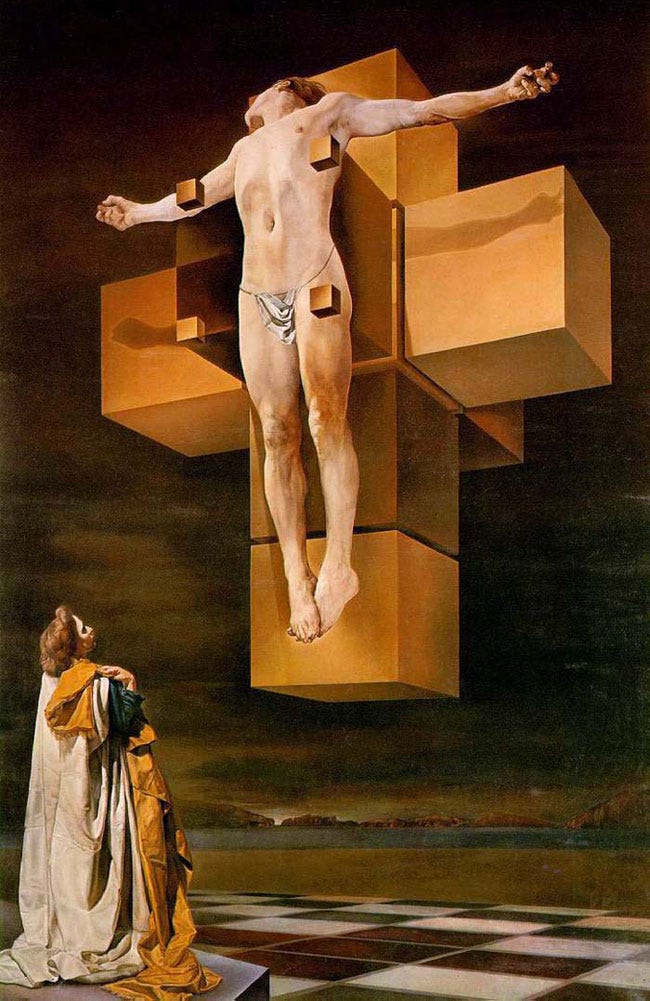
This is Salvador Dali’s painting Corpus Hypercubus (renamed Crucifixion). In Objectively Speaking (p. 115) Rand tells an interviewer that it was her favorite painting. She also says that one did not have to buy into the explicit philosophy of a religious work of art to find great value in it. The painting portrays a stylized Jesus floating in air before the net of a hypercube. This Jesus has no crown of thorns or nail holes. His body is beautiful and beardless. It transcends the earthly crucifixion. It seems to me clearly to represent Christ’s essence as spirit. Rand did occasionally use the term “spirit” in a positive sense, but perhaps she was focusing on other aspects of the painting. For her, “It expresses man’s triumph over pain. It expresses a glorified view of man, and his relationship to existence.” Furthermore, in 100 Voices Allan Gotthelf reports that the painting “reminded her of Galt’s bearing on the torture rack.” (p. 330)
It is possible that Rand saw the painting before she wrote the torture scene in Atlas Shrugged because the Metropolitan Museum of Art in New York City (where Rand lived) acquired it in 1955 and Atlas was published in 1957. But she probably plotted the scene years before that, so there’s little chance of actual influence. However, what is certain is that she did not find it objectionable to link Galt with Jesus, even the sacrificed Jesus, at a sense-of-life level. And sense of life is for Rand the very stuff of art. Representing a “triumph over pain,” is something that clearly meant a great deal to Ayn Rand. This is an unequivocal example of Galt as Christ figure in her own psyche.
12. Conclusion
Why did Rand create an alternative Christ figure in Galt? I see, and here I am speculating a bit, three possible reasons: 1. It added texture and weight to the novel. 2. It allowed her to rewrite the Christ myth so as to project a perfect man who blesses the earth and does not embrace sacrifice. 3. It reflected her vision of the perfect man as Christlike in some essentials: He would be so self-made as to have a “miraculous” origin, he would work (technological) miracles, he would change the world by his words and deeds, he would triumph over pain, he would be the greatest man who ever lived etc. Galt’s secularized Christlike qualities are perhaps the qualities she saw the ultimate man possessing, and she wanted that man to be “real,” even if she had to create him herself.
The “cash value” of likening Galt to Christ is that we get from both a feeling of worship, not just general hero worship, but absolute worship that comes from encountering the ne plus ultra of man.
To say that Rand set out to create an alternative Bible is not much of an exaggeration. As a biographical question that is outside the scope of this essay, it is worth pondering whether even an atheist like Ayn Rand needed a savior-god in her life. Maybe, as some thinkers have claimed, there is a “God-shaped hole” in all of us, or at least in many of us, regardless of whether or not there exists a God to fill it. Perhaps art can help us refrain from turning to an invalid and unwholesome mysticism for our completion.
What all this tells me in the end is something that I have discovered again and again: Ayn Rand is deeper and subtler than I thought her to be. Even though I personally am not comfortable with the idea of man worshipping or serving man, I have to admit that Rand created a man worth worshipping if there ever could be one, assuming one can get on board with her ethics. But I think Rand’s followers should ask themselves whether, after having evicted the old Christ from their souls, they should invite a new one in. But maybe they don’t think of the issue in that way. Perhaps, as Rand would no doubt say they should, they see John Galt as a symbol of the kind of greatness that they—and all human beings—can attain, on whatever scale they can attain it.
I find that interpretation plausible and well argued. But I would add two points:
On one hand, if Galt is a Christ figure, he seems to be something of a Gnostic one. The world where Dagny and Hank live and suffer is a realm of suffering where they are trapped by illusion—by their own false premises. And Galt's Gulch appears to be the true reality that is their natural home.
Galt's return to the world in Part Three of the novel is not merely to carry out his crusade, or advocate his strike. He has already brought out nearly all the essential people; the only one left is Dagny, and she by herself could not prevent the collapse. But he wants to bring her out because he loves her, enough to make his own imprisonment and torture the final demonstration of the nature of the people she's working for. I'm reminded of the parallel in Kipling's "The Church That Was at Antioch," whose young Mithraist hero, Valens, is compared to Christ to Saints Peter and Paul: The slave girl he purchased as a concubine cries out ‘He is mine—mine! I testify before all Gods that he bought me! I am his. He is mine.’ Galt, like Christ, is there for love.
A fun essay that will rile the strict Randians, which is always a worthy goal. However, to the extent you’ve proved your point, you’ve also proved something you likely didn’t intend. I’ll get back to you on that, but I admire your persistence in re-analyzing Rand. Very few of her adherents are willing to peer beyond the surface of her work. Her declaration “I mean it!” Seems to have frozen thoughtfulness among her fans. You seem to be an exception. Good work!