
The Bride!
A Frankenstein monster of a movie

There’s a concept from literary criticism you have to know in order to understand Maggie Gyllenhaal’s new film The Bride! You probably know it already but perhaps you don’t know the word for it. The word is “intertextuality.” It was coined by Bulgarian-French critic Julia Kristeva and refers to the ways in which texts (which can include movies) borrow from other texts.
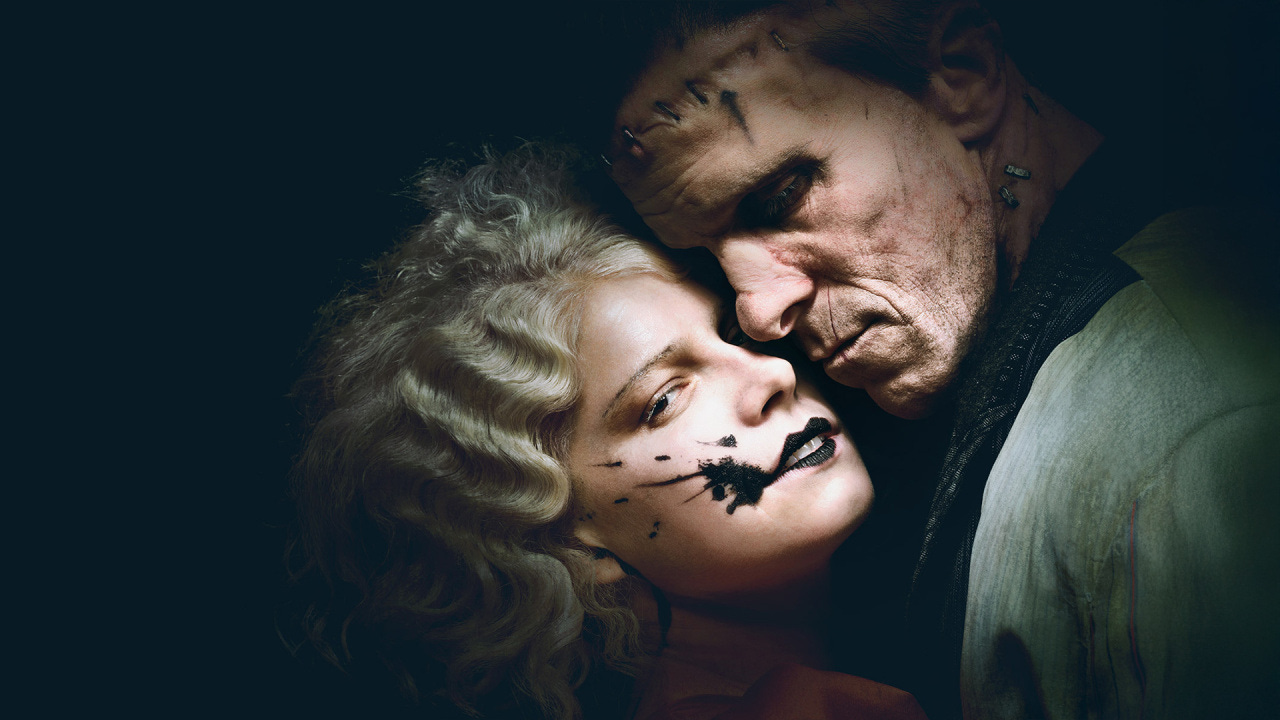
Everyone knows that The Bride! borrows the movie The Bride of Frankenstein and the movie Bonnie and Clyde, but I’m not sure people see how deep the borrowing goes or how much The Bride! borrows from other movies and stories. For example, Peter Sarsgaard and Penelope Cruz play two Chicago cops who chase Frankenstein and the Bride. The Cruz character is the brains of the duo, even though officially she is just a secretary. She uses a clever technique to predict the fugitives’ movements, based on showings of movies with Frank’s favorite actor. The prediction of movements is not in the 1967 Bonnie and Clyde though, but Frank Hamer, the lead Texas Ranger who chased the real Bonnie and Clyde, did predict their movements, and that makes it into the movie The Highwaymen, which is about the chase from the law officers’ perspective.
And what about Frank’s love of cinema? It’s right out of Interview with the Vampire, in which the vampire Louis goes 150 years without seeing the sun until he can see it at the movies. Frank can’t see real glamour and gaiety, but he can fantasize about them and project himself into dance numbers by going to movies starring an actor played by Maggie Gyllenhaal’s brother Jake in a Fred Astaire turn.
And when Frank and the Bride meet the Jake character at a party, they end up part of a big dance number to an instrumental version of “Puttin’ on the Ritz,” which you may recall was the song Freddie Frankenstein and the Monster sing and dance to in Young Frankenstein.
It goes on and on. There are allusions to Thelma and Louise and The Silence of the Lambs which I will not spoil by spelling out. I will mention one more allusion, however: the woman whose “reinvigorated” corpse becomes the Bride is named Ida, and the gangster who wants her killed (again) is named Lupino. Ida Lupino was a British-American actress who became a director in the 1950s, in a path parallel to The Bride!’s Maggie Gyllenhaal. Ida Lupino did some socially relevant films. This alone would suggest a feminist theme, but that theme would be hard to miss, for the movie is largely about the Bride’s self-liberation, as well as the liberation of many other women in the movie.
Men don’t come off looking too good in the movie, except for Frank, who is a decent sort for a monster who kills people once in a while (seemingly for good reasons). He is a lonely monster who wants a mad scientist to create a mate for him, that’s all. And the mad scientist, who in this version is a woman, played by Anette Benning, complies.
But the women in the story are not all good. The one who gets the events going is the ghost of Mary Shelley, author of the novel Frankenstein. She is played by Jessie Buckley along with Ida/the Bride. Mary is almost malevolent. She wants to continue her story with a female creature and she manages to possess Ida in the 1930s, getting her killed due to her bizarre behavior, setting in motion her reanimation. She possesses the Bride a little sometimes, but more often she just has hurtful conversations with Ida’s head trapped in a jar.
I get the feeling that Mary was trying to carry out the project of her mother Mary Wollstonecraft (author of the landmark feminist work The Vindication of the Rights of Women) by inspiring women to become “monstrously” assertive and ready to defend themselves. But that’s speculation on my part.
There is an awful lot going on in this movie. I’m not sure it comes together, although I think I’ve integrated it as well as I can on one viewing without closed captions. At any rate it’s a wild ride. Jessie Buckley (who I loved in Hamnet) and Christian Bale (as Frank) are wonderful, as are the rest of the cast. It looks good. It’s exciting. It gave my wife and me plenty to mull over, which is always a sign of a worthwhile film. I can’t give it five stars because it threatens to fly apart at the seams, but I can give it a solid four, and I recommend it, especially to those who like variations of the Frankenstein story, as I do.